
Here’s your job site problem with a regular pour: you’re at the mercy of weather, crew, and the clock. Everybody’s seen a pour pushed back a day because the forecast turned.
Precast concrete skips all that. It’s made somewhere else first, a plant, under a roof, with the same conditions on every single piece. Then it ships to your site already hardened, ready to set.
That’s the trade. You give up pouring it right there, you get consistency instead. Here’s what it actually is, how it gets made, and where it beats a job site pour.
So, What Exactly Is Precast Concrete?
Precast concrete is concrete poured and cured somewhere other than the final job site. A plant pours it into a reusable mold, lets it harden under controlled conditions, ships the finished piece out for install.
That’s the whole definition: not a special mix, not a different material, just the same concrete made somewhere else.
I’ve had guys ask me if precast’s a stronger concrete. It’s not. Same mix you’d run on site, most of the time. What changes is where it cures and how.
How Precast Concrete Is Made

Precast follows the same three steps every time, whether it’s a wall panel or a bridge girder. Doesn’t matter the size.
1. Molding and Reinforcement
Workers pour into a reusable steel or fiberglass mold shaped for that piece. Most of those molds get lined with rebar or steel cable first, that reinforcement is what handles the stress of shipping and lifting it into place later, not just holding the load once it’s installed.
2. Same Materials as Any Pour
Precast doesn’t start with a special mix. It’s cement, aggregate, water, and admixtures, the same ingredients you’d find in a job site pour.
What changes is precision: the mix gets batched and the reinforcement gets placed on a bench under consistent conditions, not standing in a form on site.
Plants also tend to run the mix a little stiffer than a standard pour, dry enough to hold its shape coming out of the mold early.
3. Controlled Curing
The piece cures inside the plant, not out on a site. That’s where precast earns the reputation.
Crews control temperature and humidity the whole time it’s curing. Some plants steam cure, raising the temperature to speed up strength gain without weakening the mix.
Vibration matters just as much. You vibrate the wet concrete in the mold to force the trapped air out before it sets. Skip that step and you get honeycombing, small voids inside the concrete that weaken it down the line.
On a job site pour, that’s on the crew to catch by hand, and hand work isn’t consistent work.
A plant runs the same vibration pattern on every single piece. That’s why precast comes out denser than an outdoor pour, pretty much every time.
4. Delivery and Assembly
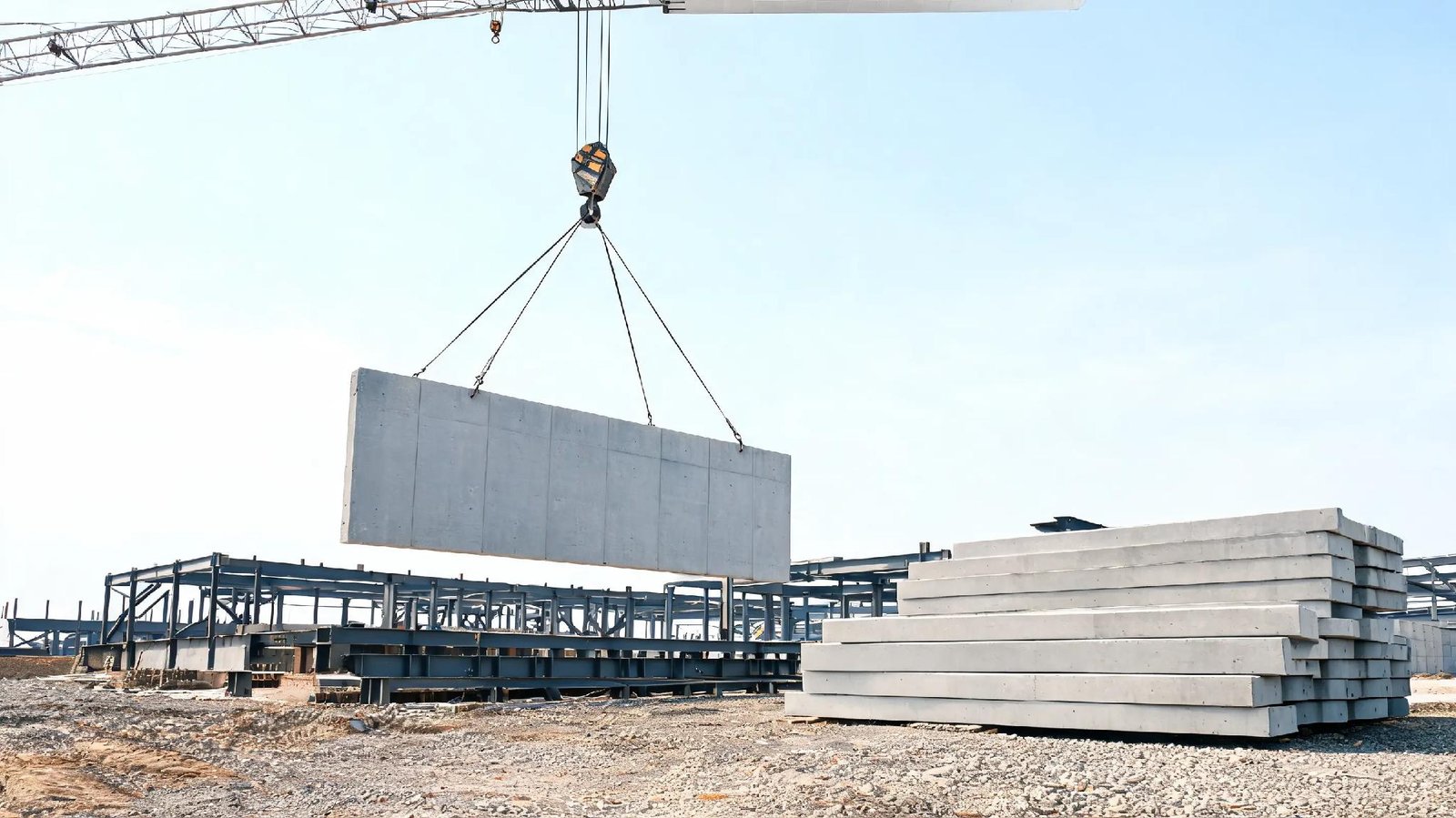
Once it hits full strength, it gets trucked to the site and set with a crane. This is where precast actually saves you time, the piece shows up ready to install. Not ready to be poured.
What Precast Concrete Is Used For
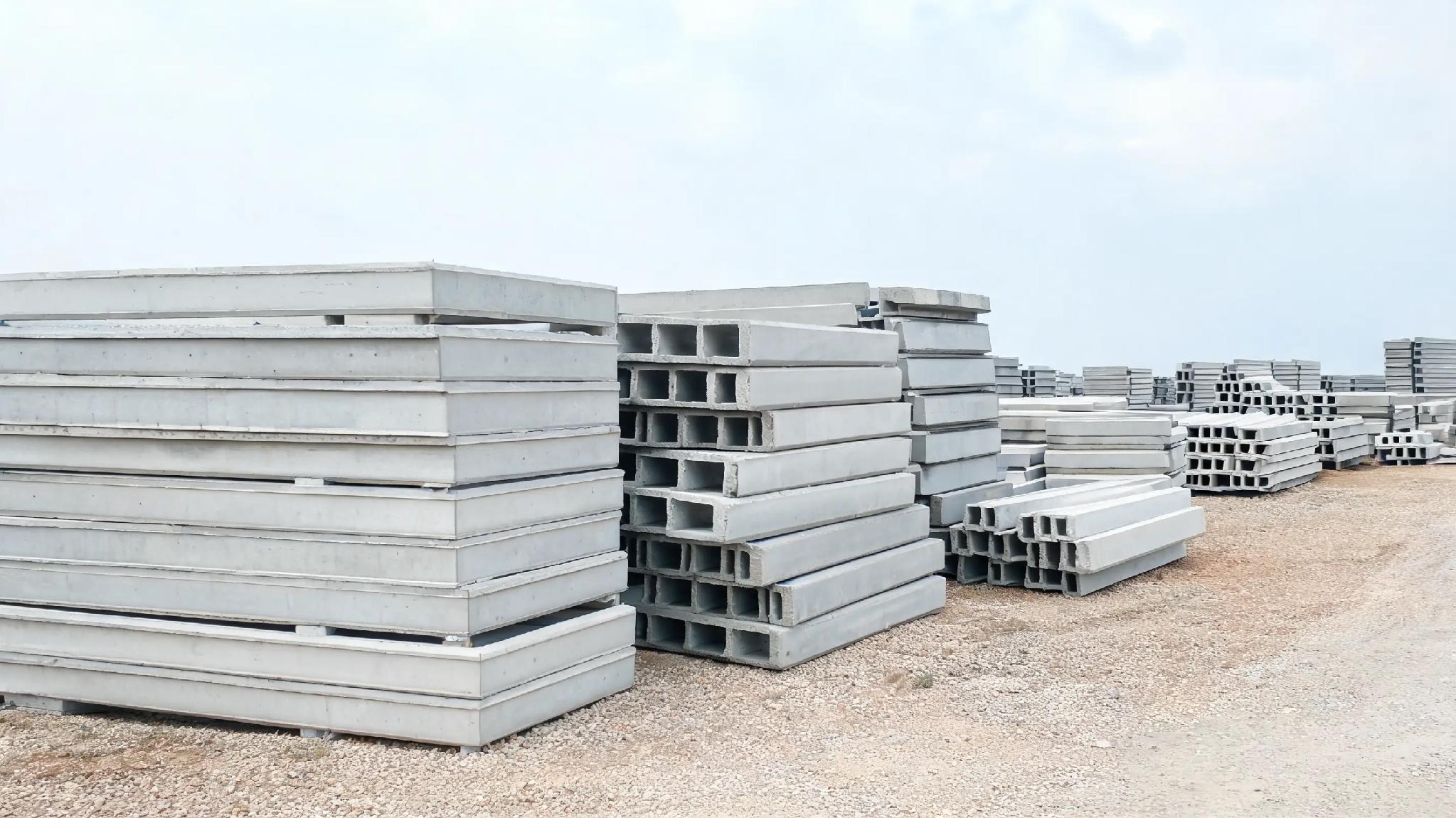
Precast shows up anywhere a builder needs a strong, repeatable shape without pouring it in place. Three categories cover most of what you’ll run into on a job:
- Structural elements: beams, columns, floor slabs, hollow-core planks, double-T sections
- Building enclosures: wall panels, facade units, insulated sandwich panels
- Infrastructure: bridge girders, utility vaults, manholes, sound walls, retaining walls, traffic barriers
You’ll see precast most where the same shape repeats dozens or hundreds of times. That’s exactly what a factory mold is built for, repetition.
Precast vs. Cast-in-Place Concrete
Precast isn’t the only way to build with concrete, and it’s not always the right call.
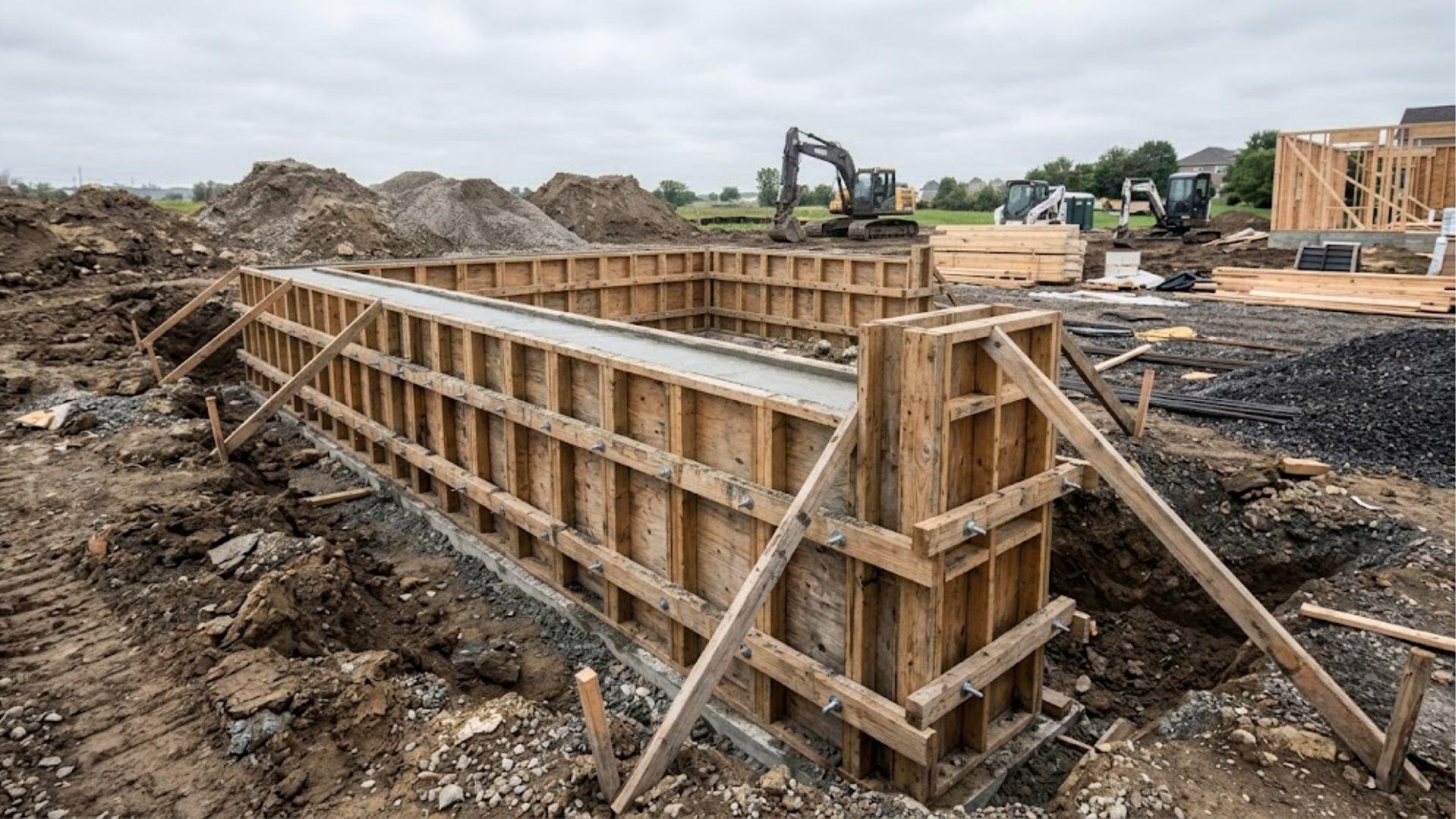
Cast-in-place is poured and cured right on the job site, in forms built for that exact spot. It’s the traditional approach. Still the default for a lot of the work out there.
Neither one wins across the board. Here’s how they actually stack up.
| Factor | Precast | Cast-in-Place |
| Speed | Faster, factory work runs while site prep happens | Slower, the pour waits on site prep and weather |
| Consistency | High, same controlled conditions on every pour | Varies, depends on weather and the crew that day |
| Design flexibility | Limited to standard mold shapes | High, shaped and adjusted on site |
| Best for | Repeatable shapes, like parking garage panels | Irregular work, like a custom foundation |
I lean precast when the shape repeats. I lean cast-in-place when it doesn’t. That’s about as simple as I can put it.
One more thing worth clearing up, precast and reinforced concrete aren’t the same category. People mix those up all the time.
Precast describes where the concrete is made. Reinforced describes what’s inside it, steel rebar or cable added for strength.
Most precast pieces are reinforced, sure, but plenty of reinforced concrete gets poured on site too. You can have one without the other.
Advantages and Disadvantages of Precast Concrete
Like any method, precast comes with real trade-offs. Here’s where it helps, and where it doesn’t.
Advantages
- Speed: the plant builds your piece while your crew’s still prepping the site.
- Quality control:factory conditions catch problems like honeycombing before they make it into a finished piece, the kind of air-void defect that’s easy to miss on an outdoor pour.
- Durability:precise curing and reinforcement hold up well against heavy loads and bad weather, with typical compressive strengths running 4,000 to 8,000 psi or higher depending on the mix.
Those three are why precast shows up so often on the big, repeatable jobs.
Disadvantages
The trade-offs show up mostly in cost and flexibility. Here’s where precast slows you down or boxes you in.
- Transport and crane costs: moving a hardened piece and lifting it into place isn’t cheap.
- Size and weight limits: it has to fit on a truck, that caps how big a single unit can get.
- Less design flexibility: you’re working inside standard mold shapes, not a custom pour.
The one that catches people off guard is the crane cost. You’re not just paying for the concrete. You’re paying to move and set something that already weighs every pound it’s ever going to weigh.
The Bottom Line
Precast concrete is concrete poured and cured off site, then shipped and set once it’s already hardened. Same material. Different process.
It wins on speed and consistency for repeatable shapes, panels, beams, that kind of thing. Cast-in-place still wins when the job needs custom, on-site flexibility.
Match the method to the shape you actually need and you’ll land on the right answer most of the time.
Frequently Asked Questions
What Is the Downside of Precast Concrete?
Transport and crane costs, plus size limits on what you can ship. A precast piece can’t be adjusted on site the way a cast-in-place pour can either, so design changes after the mold’s set are hard, sometimes impossible.
What Is the Difference Between Precast Concrete and Reinforced Concrete?
Precast is about where the concrete’s made, off site, in a factory mold. Reinforced is about what’s inside it, steel rebar or cable for strength. Most precast’s are reinforced, but reinforced concrete gets poured on site plenty too.
What Is the Advantage of Precast Concrete?
Speed paired with consistency. Factory curing takes weather delays off the table and produces the same quality every time, and site prep runs in parallel instead of waiting on a pour to finish first.
How Expensive Is Precast Concrete?
Depends on the project, piece size, transport distance, crane needs, site access, it all factors in. Precast can cut labor and timeline costs through faster install, but transport and equipment can eat into that. Compare it job by job. Don’t assume one method’s always cheaper.