
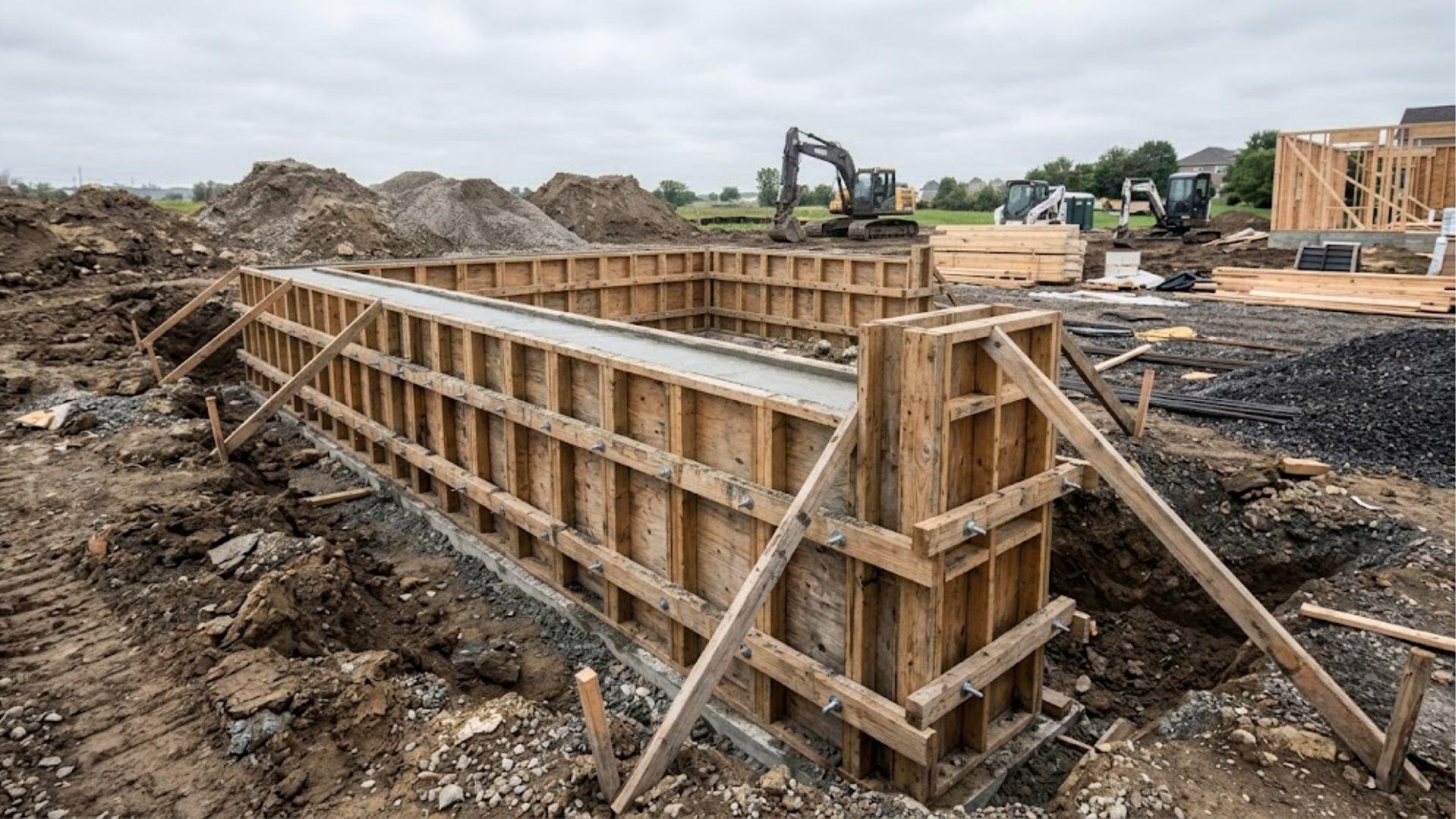
Why do crews argue over footing depth before a single form goes up? Because that first stretch of work decides more than most homeowners realize. Get it wrong, and nothing poured later corrects it.
Poured concrete is one of the most common types of concrete foundations, but it gets talked about like a single product when it’s really a sequence of decisions, each one setting up the next.
So that changes how you should think about the whole process, right?
Not as one pour, but as a sequence of steps, where getting the first one wrong undoes everything after it.
This guide walks through that sequence the way it actually plays out on a build. Let’s start where every pour does.
What Needs to Happen Before Concrete Is Poured?
Before any truck shows up, the ground has to be ready. Crews dig down to solid, undisturbed soil and pour the footings first.
Here’s the thing about those footings: they need time to cure before anything goes on top of them. Pour walls on green footings and you’re loading weight onto concrete that hasn’t built its strength yet.
So that’s trouble you’re setting up early, even if it doesn’t show for years.
Once the footing has set, forms go up right on top of it. Wood, steel, aluminum, insulated concrete forms, the material depends on the build. That’s a real trade-off, not a style choice.
Each option shifts cost, labor, and insulation performance in a different direction.
I think it’s important to note that most stalled jobs trace back to the soil, not the crew. Clay-heavy or waterlogged ground changes how deep you dig and how you handle drainage before a single form gets set.
Skip that step, and no amount of careful pouring later will save the foundation.
How Is a Poured Concrete Foundation Actually Poured?
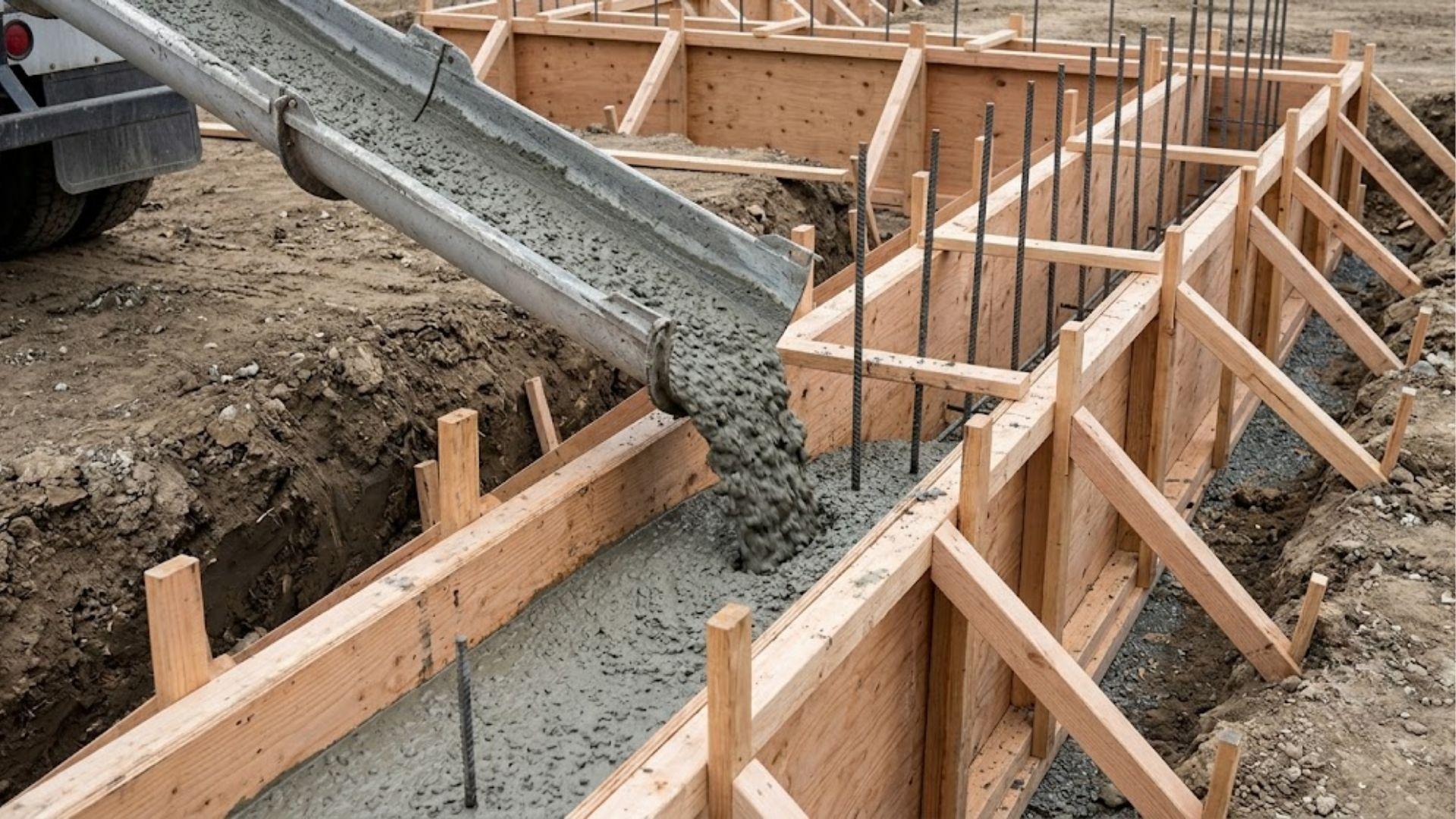
Once the forms are set, the process comes down to three steps: reinforce, pour, cure. Each one sets up the next, and skipping ahead on any of them shows up as a problem down the line.
Reinforcement
Before any concrete goes in, crews place steel rebar inside the forms. That’s not extra strength for show. It’s covering a gap in what concrete can do on its own.
Concrete handles compression well, meaning it resists being crushed. It’s weak against bending and pulling forces, and that’s exactly where rebar steps in.
Together, they cover both sides of the load: the concrete resists crushing, the rebar resists bending and cracking under pressure. Right, that’s the pairing that makes the wall work as a system instead of just a mass of material.
The Pour
With rebar in place, ready-mix trucks deliver concrete straight into the forms, and it goes in as one continuous fill, not in separate stages. That matters more than it sounds like it should.
A continuous pour means no weak seams forming partway through the wall. We’ll come back to why that seam issue matters so much when we get to block comparisons.
Curing
Here’s where most people get it wrong. Forms usually come off within a few days of the pour, and that reads as finished to most eyes.
It isn’t. Concrete keeps gaining strength for weeks after the forms are gone. I’ve seen crews backfill or frame on top too early, right after form removal, because the wall looks done. It hasn’t reached full strength yet.
Treat form removal as a milestone, not a finish line. Full cure takes real time, and rushing it costs you later, usually in cracking or bowing that didn’t have to happen.
Why Does Pouring the Wall in One Piece Make It Stronger?
It’s not the concrete itself that makes the difference. It’s the absence of joints running through the wall.
A poured wall goes in as one continuous mass. Footing, wall, and rebar bond into a single structure with nothing breaking it up. Block walls work differently.
Every block is stacked and held together with mortar, which means hundreds of joints running through the structure.
Each joint is a potential weak point. Water finds those seams first, and so does cracking under pressure. A poured wall skips all of that.
There’s no seam for water to work through, and no joint for pressure to split open.
That’s also why poured walls test out at roughly double the compressive strength of the block. It’s not a different material doing the work, it’s one solid mass instead of hundreds of stacked pieces.
Once you see it that way, ‘fewer leaks’ stops being a vague selling point. It’s a direct result of how the wall is built.
Where Do Poured Concrete Foundations Still Break Down?
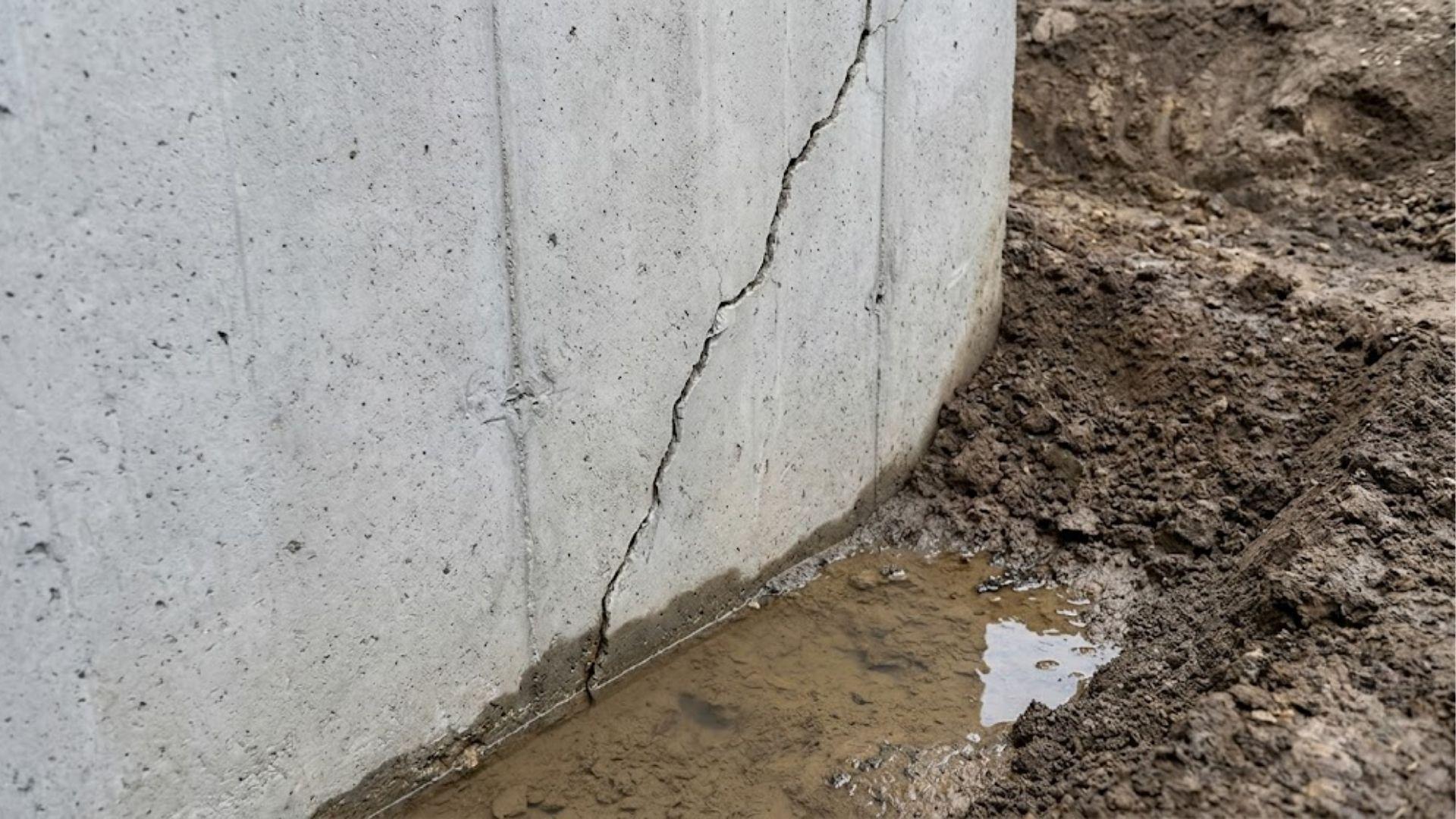
A one-piece pour lowers the risk of failure. It doesn’t remove it completely, so it’s worth saying, because an unrealistic promise helps no one.
Problems still show up, usually tied to the ground around the wall or how the build was handled afterward. Here’s where things go wrong:
- Soil pressure and settling. Ground shifts over time, and that pressure can still crack a poured wall. No mortar joints doesn’t mean no weak points.
- Poor drainage planning. A poured wall resists water better than block, but only if water is directed away from it. Skip proper grading or drainage, and that natural resistance gets undercut fast. Water doesn’t care where your landscaping looks nice, it pushes at the weakest point until something gives.
- Backfilling too early. Pushing soil against the wall before it’s fully cured puts pressure on concrete that hasn’t reached full strength. That’s when cracks and bowing start.
None of these are flaws in the pour itself. They’re what happens when the ground work or the timing around it gets rushed.
Making Your Foundation Pour Count
Strength in a poured concrete foundation isn’t automatic. It comes from getting the sequence right: solid footings, proper reinforcement, a continuous pour, and enough time to cure before the wall takes on load.
Rush any one of those, and the foundation underneath your home pays for it.
If you’re at the planning stage, get a qualified foundation contractor to walk your site before any concrete gets ordered. That’s good upfront verification, and it’s a lot cheaper than a repair conversation later.
Frequently Asked Questions
How long will a poured concrete foundation last?
A properly built poured foundation can last well over 100 years. That depends on drainage, soil conditions, and giving the concrete enough time to cure before it takes on load. Skip proper waterproofing, and even a strong pour won’t reach its full lifespan.
How much does it cost to pour a 20×20 concrete foundation?
Cost depends on your region, soil conditions, and how much excavation the site needs. There’s no single number that applies everywhere. Get a quote from a local contractor who can walk your site first.
Is it cheaper to pour a slab or a foundation?
A slab usually costs less than a full foundation with footings and walls. It skips the extra excavation, forms, and rebar a foundation wall needs. The right choice comes down to whether your build needs a basement or crawl space.
How much does it cost to pour a 2000 sq ft foundation?
Total cost scales with square footage, but depth, soil type, and local labor rates all shift the number too. A per-square-foot estimate only gets you so far. A site visit from a local contractor gives you a number you can actually plan around.